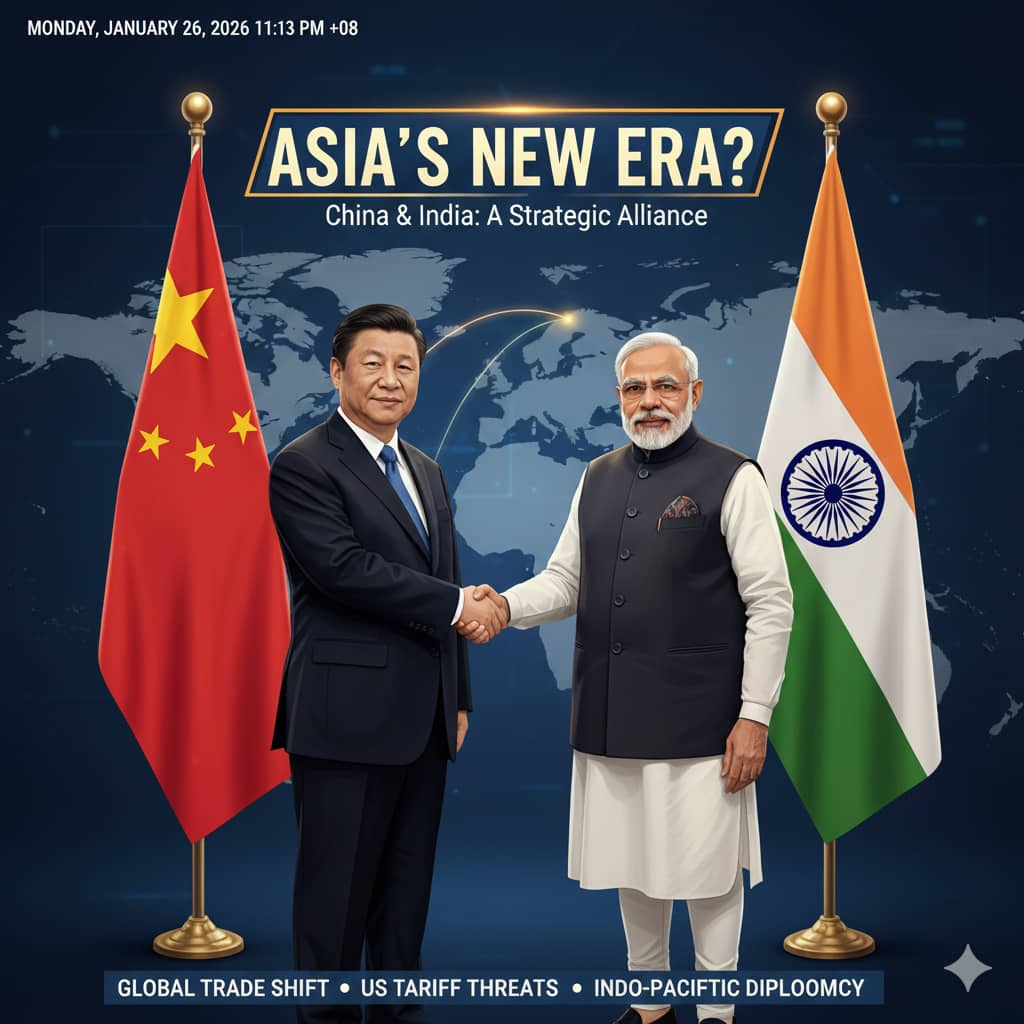
In a significant diplomatic overture, Chinese President Xi Jinping extended a rare message of goodwill to India on its 77th Republic Day, observed on January 26, 2026. In a move that has sent ripples across global geopolitical circles, Xi referred to India as a “friend and partner” and emphasized the shared destiny of Asia’s two largest nations. This unexpected olive branch comes amidst escalating rhetoric from the newly-elected U.S. President Donald Trump, who has reignited fears of a global trade war, particularly targeting China and its allies.
The Timing: A Republic Day Diplomacy
President Xi’s message, conveyed through diplomatic channels and later publicized by the Chinese Foreign Ministry, coincided with India’s Republic Day parade in New Delhi. While cordial greetings are standard diplomatic practice, the specific phrasing — “friend and partner,” coupled with calls for deeper bilateral trust — carries significant weight given the often-strained relationship between the two nuclear powers.
Historically, India and China have been locked in a complex relationship marked by border disputes, economic competition, and strategic mistrust. However, the current global climate appears to be prompting a re-evaluation of these dynamics.
The Shadow of the US Trade War
The most immediate context for Xi’s outreach is the aggressive protectionist stance of the new U.S. administration. President Trump has repeatedly threatened to impose a universal 10% tariff on all imported goods and has specifically singled out China for alleged unfair trade practices. His rhetoric has sparked concerns of a renewed “trade war” that could destabilize global supply chains and lead to an economic slowdown.
For China, a closer relationship with India could offer a crucial strategic and economic buffer. India’s massive domestic market, growing manufacturing base, and increasingly influential role in global affairs make it an indispensable partner in any effort to counter Western economic pressure.
India’s Stance: Strategic Autonomy
India, under Prime Minister Narendra Modi, has consistently pursued a policy of “strategic autonomy,” balancing its relationships with major global powers without aligning exclusively with any single bloc. While India has been a key member of the Quad (Quadrilateral Security Dialogue) — a grouping seen as a counter-balance to China’s influence in the Indo-Pacific — it also recognizes the pragmatic necessity of engaging with its largest neighbor.
India’s Ministry of External Affairs acknowledged President Xi’s message as a positive step but reiterated that “normalcy in relations requires mutual respect for sovereignty and territorial integrity.” This indicates that while New Delhi is open to dialogue, it will not compromise on its core national interests, especially concerning border issues.
Potential Areas of Cooperation and Conflict
Despite the diplomatic warmth, significant challenges remain. The ongoing border standoff in Ladakh, while de-escalated, has not been fully resolved. However, President Xi’s message could pave the way for renewed discussions on:
Trade: India and China are already significant trading partners, though India faces a substantial trade deficit. A more stable relationship could lead to fairer trade practices and increased market access.
Climate Change: Both nations are major emitters and could collaborate on green technologies and sustainable development goals, potentially setting an Asian agenda.
Regional Stability: Cooperation on issues like counter-terrorism, disaster management, and regional connectivity projects could benefit the wider Asian continent.
Conclusion: A Precarious Balance
President Xi Jinping’s overture to India is a clear strategic move designed to navigate a turbulent global environment. As the threat of a U.S.-led trade war looms large, China is actively seeking to solidify its relationships with key Asian powers. India, in turn, faces the delicate task of leveraging this opportunity for its own benefit while carefully guarding its strategic independence. The coming months will reveal whether this diplomatic goodwill can translate into tangible improvements, transforming a complex rivalry into a genuine “friend and partner” relationship