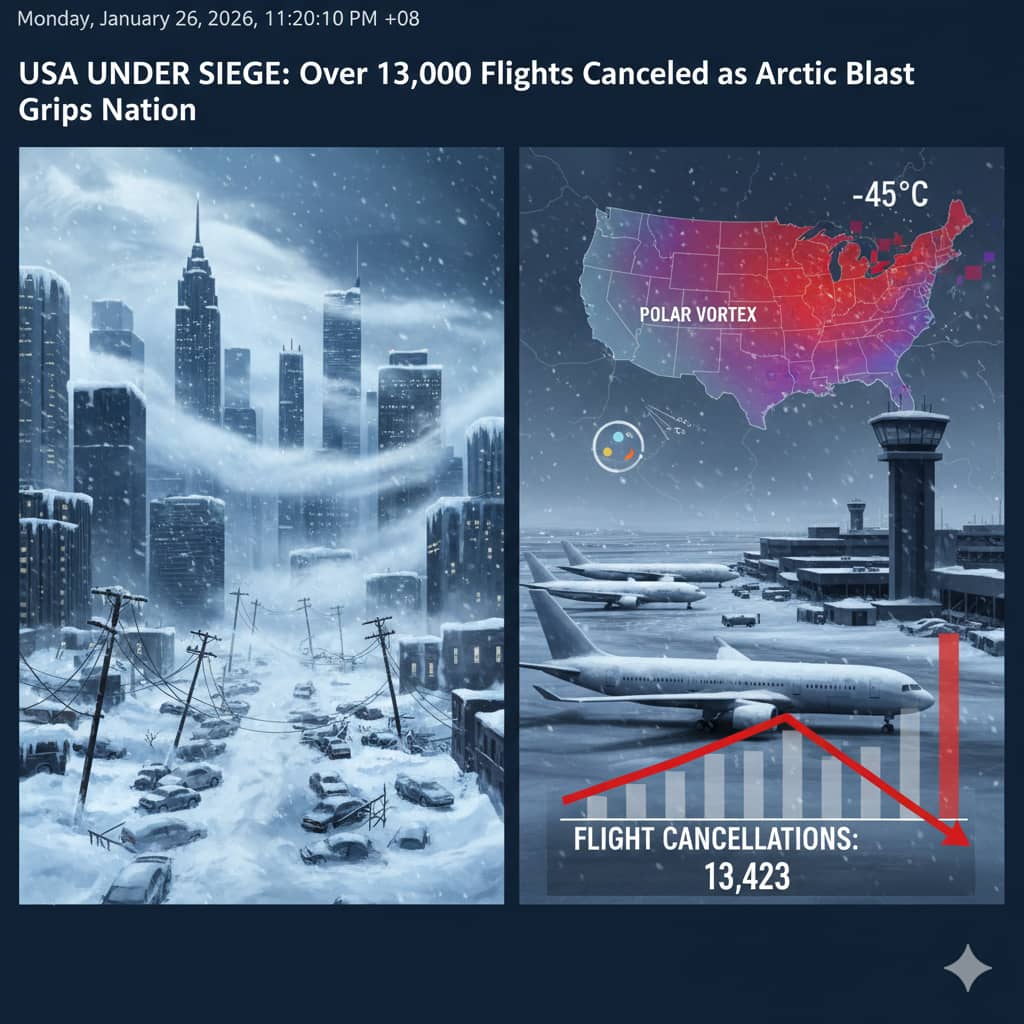
WASHINGTON D.C. – A catastrophic winter storm of historic proportions is currently battering a vast swath of the United States, leaving millions without power and grinding the nation’s transportation network to a halt. As of January 26, 2026, meteorologists have labeled this event a “generational polar vortex,” with life-threatening temperatures and heavy snowfall stretching from New Mexico all the way to New England.
The scale of the disruption is unprecedented. Federal aviation authorities confirmed this morning that over 13,000 flights have been canceled nationwide, leaving hundreds of thousands of passengers stranded at major hubs including Chicago O’Hare, Denver International, and New York’s JFK.
The “Polar Plunge”: Record-Breaking Cold
The storm, fueled by a deep dip in the jet stream, has sent temperatures plummeting to levels not seen in decades. In parts of the Midwest, wind chill factors have reached a staggering -45°C, a temperature at which frostbite can occur on exposed skin in less than five minutes.
Over 140 million Americans—nearly 40% of the population—are currently under some form of winter weather alert. Governors in seven states, including New York and Michigan, have declared a State of Emergency, urging residents to stay off the roads as “whiteout” conditions make travel virtually impossible.
Grid Failure and Infrastructure Stress
Beyond travel chaos, the extreme cold is putting immense pressure on the US energy grid. In Texas and the Southeast, energy providers have initiated “rolling brownouts” to prevent a total collapse of the system as heating demand hits record highs.
Public works departments are struggling to keep up with the snowfall, which has topped 30 inches in parts of Buffalo and Erie. Meanwhile, aging water infrastructure is failing under the freeze, with hundreds of water main breaks reported in cities like Philadelphia and Baltimore, leaving thousands without access to running water.
Economic Impact: Billions at Risk
Economists warn that the “Great Freeze of 2026” could have a lasting impact on the Q1 GDP. With major manufacturing plants in the “Rust Belt” forced to suspend operations and the logistics sector paralyzed, the daily economic loss is estimated to be in the hundreds of millions of dollars. Small businesses, particularly in the retail and hospitality sectors, are bearing the brunt of the storm as consumers remain trapped in their homes.
Federal Response and Safety Warnings
President Donald Trump addressed the nation briefly from the White House, stating that the Federal Emergency Management Agency (FEMA) is coordinating with state authorities to provide emergency heating centers and food supplies. National Guard units have been deployed in the hardest-hit regions to assist with search and rescue operations for stranded motorists.
The National Weather Service (NWS) has issued a stern warning: “This is a life-threatening situation. If you do not need to travel, stay indoors. The combination of heavy snow and extreme cold is a deadly mix.”
Looking Ahead: When Will the Thaw Begin?
Forecasters predict that the Arctic air mass will remain locked over the eastern half of the country for at least another 72 hours. While a slight warming trend is expected by the weekend, the transition could bring a new set of dangers, including rapid snowmelt and potential flash flooding.
For now, America remains a nation under ice, waiting for the grip of winter to loosen its hold.