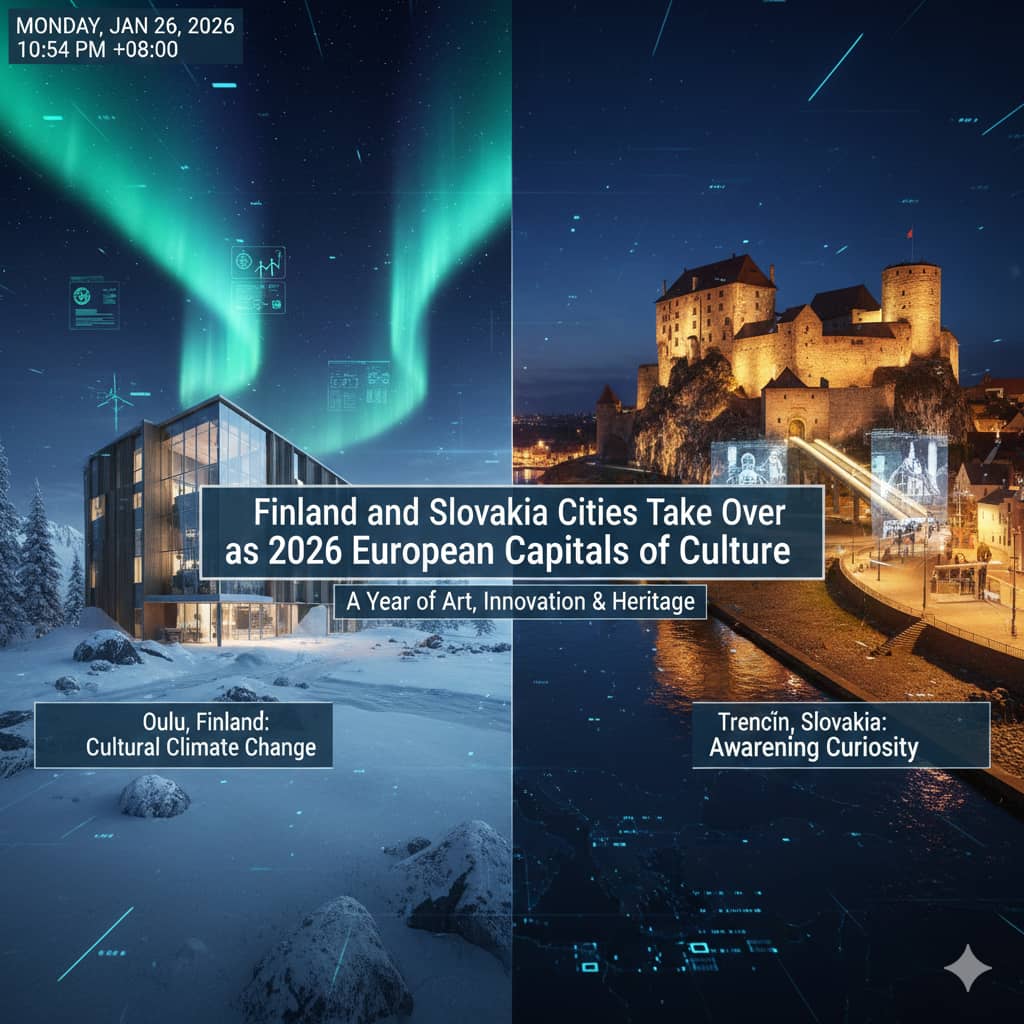
The year 2026 marks a vibrant milestone in European history as the cities of Oulu (Finland) and Trenčín (Slovakia) officially assume their roles as the European Capitals of Culture (ECoC). Succeeding the 2025 titles of Chemnitz (Germany) and Nova Gorica/Gorizia (Slovenia/Italy), these two cities—separated by 2,000 kilometers but united by a shared vision—are set to transform Northern and Central Europe into grand stages of art, innovation, and community engagement.
The European Capital of Culture initiative, established in 1985, is more than just a festival. It is a catalyst for urban regeneration, a bridge between diverse cultures, and a spotlight on the unique identities that make up the European mosaic.
Oulu: The North’s Cultural Climate Change
Located just below the Arctic Circle, Oulu is Finland’s fourth-largest city and the northernmost major city in the European Union. Its theme for 2026, “Cultural Climate Change,” is as poetic as it is urgent. In Oulu, culture is seen as the tool to reconnect people with nature, science, and one another in a rapidly changing world.
Key Highlights of the Oulu 2026 Program:
Opening Festival (January 16–18): Despite the sub-zero temperatures, Oulu launched its year with a spectacular winter festival. The city center was transformed into an “Art Village,” featuring ice music concerts, synchronized acrobatics, and even “car tuning” as a form of community art.
The Climate Clock: One of the flagship productions, the Climate Clock integrates art with environmental science. Six permanent installations across the region serve as reminders of our ecological responsibility, encouraging residents and visitors to rethink their relationship with the Arctic landscape.
Wild City and Brave Hinterland: The program extends beyond Oulu to 39 surrounding northern municipalities. Projects like “Wild City” explore the relationship between urban life and the untamed wilderness, while “Brave Hinterland” celebrates the culture of small rural villages and the indigenous Sámi people.
Lumo Art & Tech Festival: Oulu is a global hub for technology, and in 2026, its famous Light Festival will expand to include cutting-edge media art, interactive installations, and digital storytelling, showcasing the “Northern Lights” of human creativity.
Trenčín: Awakening Curiosity in Central Europe
While Oulu looks to the Arctic, Trenčín—nestled in the Váh River valley of western Slovakia—invites the world to rediscover Central European history through the lens of “Curiosity.” Known for its iconic medieval castle perched on a limestone cliff, Trenčín aims to use 2026 to “awaken curiosity” about the past, the future, and the “invisible” connections between people.
Key Highlights of the Trenčín 2026 Program:
The Grand Opening (February 13–15): Trenčín’s celebration begins in mid-February, focusing on the revitalization of its historic center. The program features “community breakfasts,” grand parades, and a festive evening ceremony that turns the entire city into an open-air theater.
The Fiesta Bridge: One of the most symbolic projects involves transforming an old, disused railway bridge into the “Fiesta Bridge”—a floating cultural venue and pedestrian park. This project serves as a metaphor for bridge-building between the city’s heritage and its modern, creative identity.
The Well of Love: At the Trenčín Castle, a multimedia exhibition titled “The Well of Love” reinterprets the local legend of Omar and Fatima through contemporary art and digital projection, blending mythology with 21st-century storytelling.
Ecological Responsibility: Trenčín is focusing heavily on “Green Culture.” Many of its 500+ events are designed to be zero-waste, promoting sustainable tourism and encouraging citizens to take ownership of their local environment through “placemaking” and urban gardening.
The Economic and Social Impact
The ECoC title is a powerful economic engine. For both cities, 2026 is expected to bring a significant surge in international tourism, with hotels, restaurants, and local artisans seeing record demand. But the true legacy of the European Capital of Culture lies in its long-term impact on the residents.
By investing in cultural infrastructure—like renovated theaters, new public squares, and digital art hubs—Oulu and Trenčín are creating a permanent shift in their urban development. Studies of previous ECoC cities show that for every €1 invested, the local economy often sees a return of €5 to €8 over the following decade. Furthermore, the sense of pride and belonging among the inhabitants is immeasurable.
Building a Common European Future
In a time of global uncertainty, the programs in Oulu and Trenčín serve as reminders of what connects us. Whether it’s through a Sámi opera in Finland or an experimental theater performance on a bridge in Slovakia, the European Capital of Culture initiative fosters “European Strategic Autonomy” through soft power—the power of art and shared values.
As 2026 unfolds, Oulu and Trenčín are not just cities; they are the heart of Europe. They invite every visitor to be “wild,” “brave,” and above all, “curious.”