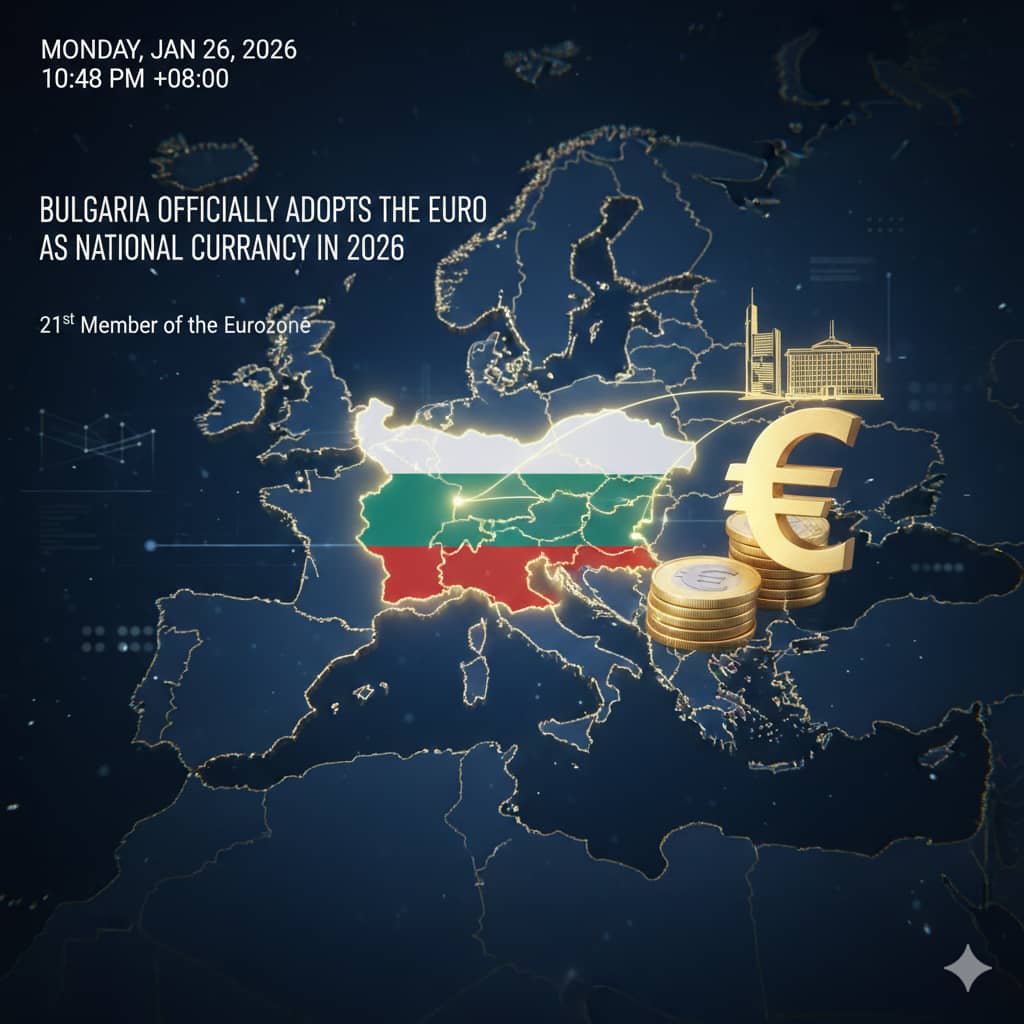
January 1, 2026, will be remembered as a monumental day in the history of Southeastern Europe. At the stroke of midnight, Bulgaria officially bid farewell to its national currency, the Lev, and became the 21st member of the Eurozone. This transition marks the culmination of nearly two decades of effort since Bulgaria joined the European Union in 2007. Despite political hurdles and public skepticism, the adoption of the Euro represents a significant leap toward full European integration and economic stability for the Balkan nation.
The Long Journey to the Euro
Bulgaria’s path to the single currency has been anything but easy. Since 1997, the Bulgarian Lev has been pegged to other European currencies—first the German Deutschmark and then the Euro itself. This long-standing “Currency Board” arrangement provided a foundation of stability, but full Eurozone membership required meeting strict “Maastricht criteria,” including low inflation, sound public finances, and exchange rate stability.
After several delays due to internal political instability and global economic shocks, the European Commission and the European Central Bank (ECB) finally gave the green light in mid-2025. This “convergence” was a testament to Bulgaria’s resilience, leapfrogging other EU members like Poland, Hungary, and the Czech Republic in the race to join the common currency area.
What the Transition Means for Citizens
From January 1, 2026, the Euro became the official legal tender in Bulgaria. To ensure a smooth transition, the government implemented a “Dual Circulation” period. Throughout the month of January, both the Lev and the Euro are being accepted in shops. However, change is consistently given in Euros, helping to gradually remove the Lev from circulation.
The official conversion rate was locked at 1.95583 Bulgarian Lev per 1 Euro. To protect consumers, shops have been required since August 2025 to display prices in both currencies. This measure aims to prevent “unjustified price increases” and ensure that the transition doesn’t unfairly burden the average citizen.
Economic Benefits: Prosperity and Security
European leaders, including EC President Ursula von der Leyen, have hailed Bulgaria’s entry as a boost for both the country and the Eurozone. The benefits are expected to be felt across several sectors:
Lower Transaction Costs: Bulgarian businesses, particularly those in the automotive and tech sectors that export heavily to Europe, will save an estimated one billion Levs annually in currency conversion fees.
Increased Investment: Being part of the Eurozone makes Bulgaria a more attractive destination for Foreign Direct Investment (FDI). It signals to global investors that the country operates within a stable, world-class monetary framework.
Cheaper Borrowing: Membership in the Eurozone typically leads to improved credit ratings, which translates to lower interest rates for government bonds, business loans, and mortgages for ordinary families.
Strengthened Voice: Bulgaria now has a permanent seat on the ECB Governing Council, giving it a direct say in the monetary policy that affects over 350 million Europeans.
The Cultural Identity of the Bulgarian Euro
While the currency has changed, Bulgarian identity remains visible on the new coins. The smaller denomination Eurocents feature the Madara Rider, a UNESCO World Heritage symbol of early Bulgarian statehood. The 1 and 2 Euro coins carry the image of St. John of Rila, the country’s patron saint. Notably, Bulgaria is the first Orthodox Christian country to feature Cyrillic script and Christian imagery on the common currency, enriching the cultural tapestry of the Eurozone.
Public Sentiment: Hope vs. Fear
Despite the economic logic, the transition has exposed a generational and regional divide. In urban hubs like Sofia and Plovdiv, the youth and entrepreneurial class view the Euro as a gateway to prosperity and easier travel. However, in rural areas, there is a lingering fear that the transition will lead to inflation—a concern fueled by misinformation on social media.
Prime Minister Rosen Zhelyazkov’s government has addressed these fears through a nationwide campaign titled “The Euro: Our Strength.” The Bulgarian National Bank (BNB) has also guaranteed that Lev banknotes can be exchanged for Euros free of charge indefinitely at its Sofia headquarters and regional offices.
Geopolitical Significance: Resisting External Pressure
Bulgaria’s entry into the Eurozone is also a powerful geopolitical statement. In an era of increased Russian influence and regional uncertainty, anchoring the Bulgarian economy to the heart of the European project sends a message of unity. It follows Bulgaria’s recent full accession to the Schengen Area, further solidifying its status as a core member of the European mainstream.
Conclusion: A New Chapter
As the lights on the ECB building in Frankfurt glowed blue and gold to welcome its newest member, Bulgaria entered a new era. The transition to the Euro is more than just a technical change of banknotes; it is a commitment to a shared future of growth, security, and integration. While the first few months of 2026 will be a period of adjustment, the long-term prospects for a “Euro-powered” Bulgaria are brighter than ever. For the “Land of Roses,” the future is now denominated in Euros