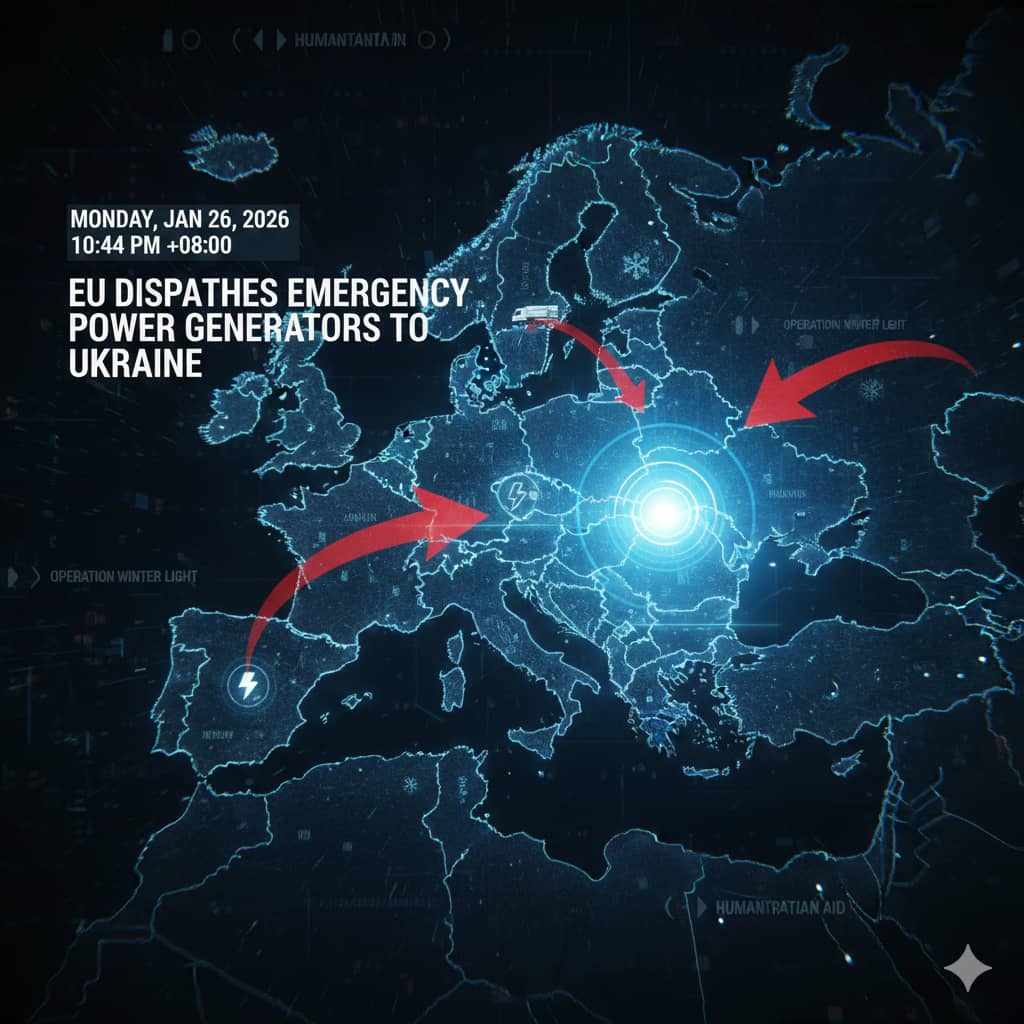
As January 2026 brings record-breaking freezing temperatures to Eastern Europe, Ukraine finds itself in the grip of its most severe energy crisis since the conflict began. With nearly 40% of the national power grid crippled by strategic strikes on substations and heating plants, the European Union (EU) has stepped forward with a massive humanitarian and technical intervention. In a coordinated effort titled “Operation Winter Light,” the EU has begun dispatching hundreds of high-capacity emergency power generators to ensure that the Ukrainian people can survive the harshest months of the year.
The Scale of the Energy Emergency
The start of 2026 saw a renewed and intensified campaign targeting Ukraine’s critical infrastructure. Unlike previous years, the focus has shifted toward destroying regional distribution hubs and thermal heating units. In major cities like Kyiv, Kharkiv, and Odesa, residents are enduring scheduled blackouts lasting up to 16 hours a day. With temperatures plummeting to -20°C, the lack of electricity is no longer just an inconvenience—it is a life-threatening situation. Without power, central heating systems fail, water pipes freeze and burst, and hospitals are forced to operate in near-total darkness.
The EU’s Strategic Response: More Than Just Generators
In response to an urgent appeal from the Ukrainian government, European Commission President Ursula von der Leyen announced a comprehensive energy support package during a press briefing in Brussels. The EU has mobilized its strategic RescEU reserves, primarily located in Poland and Germany, to deliver over 500 industrial-grade generators.
These units are not standard household generators; they are heavy-duty machines capable of powering entire city blocks or critical facilities. The deployment strategy focuses on three main pillars:
Sustaining Healthcare: A significant portion of the larger units is being diverted directly to frontline hospitals and surgical centers. This ensures that life-support systems, incubators, and emergency operating rooms remain functional 24/7, regardless of the state of the national grid.
Maintaining “Points of Invincibility”: These community hubs, where thousands of civilians gather to stay warm, charge devices, and access the internet, are being prioritized for power. The goal is to prevent a mass exodus of climate refugees by providing stable warmth within local communities.
Critical Water Infrastructure: Many of the newly dispatched generators are specifically designed to run water pumping stations. This prevents the collapse of sanitation systems, which is crucial for preventing the spread of diseases during winter.
Logistical Challenges and “Energy Solidarity”
Moving hundreds of tons of heavy machinery across war-torn borders is a monumental task. The European Union has established a dedicated logistics corridor through Poland and Romania. This operation, valued at approximately €85 million, is being managed by the EU’s Directorate-General for European Civil Protection and Humanitarian Aid Operations (ECHO).
The logistics chain includes specialized flatbed trucks and guarded convoys to protect the equipment from being targeted during transit. Furthermore, the EU is not just sending hardware. A team of specialist engineers from several member states is providing remote and on-site training to Ukrainian technicians. This ensures that once the equipment arrives, it can be integrated into the existing grid or set up as standalone “micro-grids” within hours.
The Role of the ENTSO-E Connection
Beyond physical generators, the EU is working to strengthen the synchronization between the Ukrainian power grid and the European Network of Transmission System Operators for Electricity (ENTSO-E). By 2026, this connection has become a vital artery, allowing Ukraine to import emergency electricity directly from neighboring EU countries like Slovakia, Hungary, and Romania. The current aid package includes mobile transformers and high-voltage circuit breakers to repair the damaged nodes that facilitate this international energy transfer.
Humanitarian Impact: Stories from the Ground
In the liberated territories and besieged cities, the arrival of EU-labeled generators is being met with profound relief. In Kherson, where infrastructure damage is near-total, a local hospital administrator noted, “These machines are the difference between life and death for our patients in the ICU. When the lights come on, people stop panicking.”
Small businesses, particularly bakeries and pharmacies, are also being given access to community power shares. This allows for the continued production of bread and the storage of temperature-sensitive medications like insulin, providing a semblance of normalcy amidst the chaos.
Geopolitical Significance: A United Europe
The 2026 energy intervention reinforces the geopolitical unity of the European Union. By treating Ukraine’s energy security as an extension of its own, the EU is signaling that it will not allow “energy blackmail” to dictate the future of the continent. EU Commissioner for Crisis Management, Janez Lenarčič, emphasized that this mission is a testament to European values. “We are not just sending machines; we are sending a message of unwavering solidarity,” he stated.
Conclusion: Lighting the Way Forward
The battle for Ukraine’s energy survival in the winter of 2026 is a defining moment for European cooperation. While the immediate goal is to prevent a humanitarian catastrophe, the long-term impact is the creation of a more resilient and integrated European energy landscape. As the generators begin to hum in cities across Ukraine, they serve as a beacon of hope—a reminder that even in the darkest and coldest of times, Europe stands united to keep the lights on and the people warm.