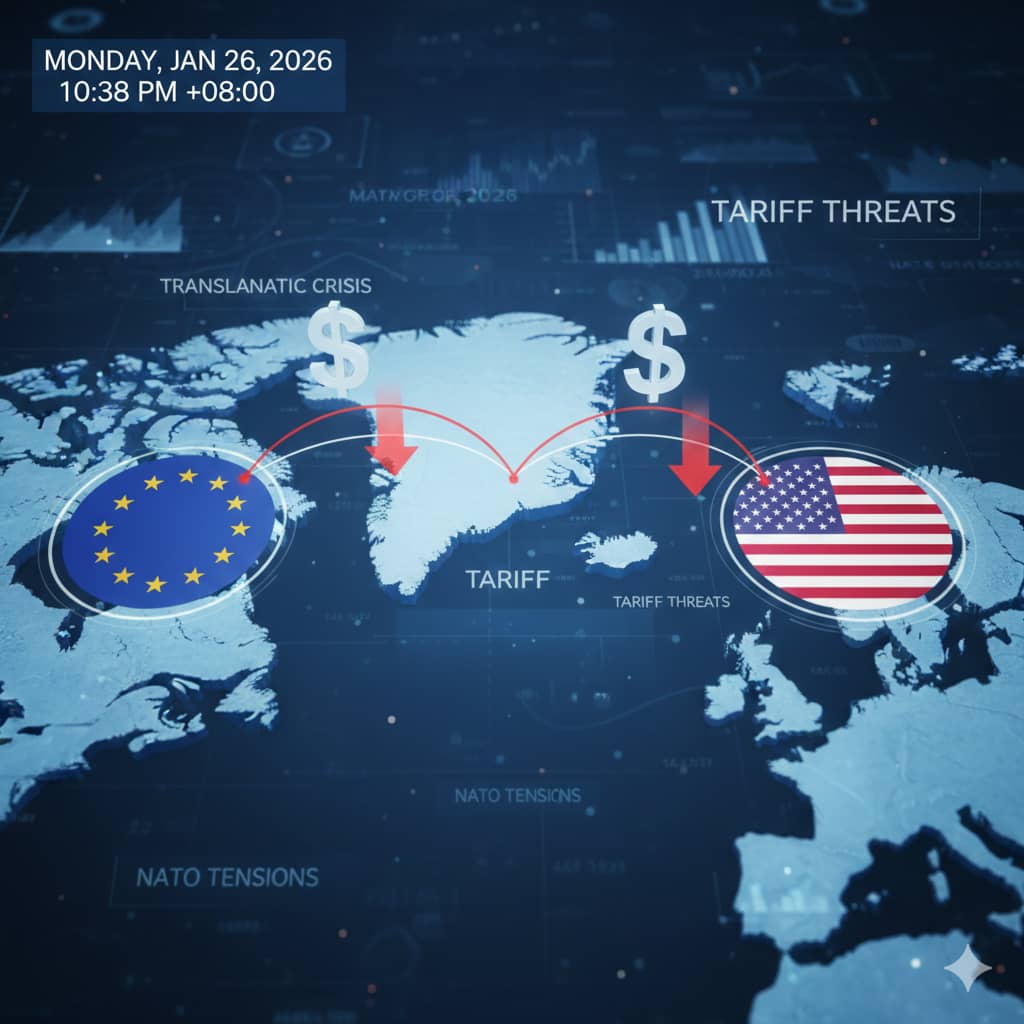
The dawn of 2026 has brought an unprecedented diplomatic and economic storm to the North Atlantic. What began as a recurring point of interest has escalated into a full-blown geopolitical crisis: the dispute over Greenland’s sovereignty. In early January 2026, the United States administration issued a bold and controversial ultimatum to Denmark and several other European allies, threatening significant import tariffs if progress is not made toward U.S. control or purchase of the Arctic island. This move has drawn fierce condemnation from European Union (EU) leaders, marking one of the most tense periods in transatlantic relations in decades.
The Root of the Dispute: Why Greenland?
The strategic importance of Greenland has grown exponentially as climate change thins Arctic ice, opening new shipping routes and providing access to vast, untapped mineral resources, including rare earth elements essential for modern technology. U.S. President Donald Trump, reigniting an interest from his previous term, has framed the acquisition of Greenland as a “national security necessity.” Washington argues that Denmark lacks the resources to protect the island from potential influence or occupation by adversaries like Russia or China.
However, Greenland is a semi-autonomous territory within the Kingdom of Denmark. For the Danish government and the people of Greenland, the territory is “not for sale.” This fundamental disagreement reached a boiling point in mid-January when Washington announced a 10% tariff on imports from eight European nations—Denmark, Finland, France, Germany, the Netherlands, Norway, Sweden, and the UK—unless a deal is reached for the “complete and total purchase” of the island.
European Response: Unity and Outrage
The response from Brussels and other European capitals was swift and unanimous. European Commission President Ursula von der Leyen described the tariff threat as a “fundamental mistake” between allies. During the World Economic Forum in Davos, she emphasized that sovereignty and territorial integrity are non-negotiable principles in international law.
”When friends shake hands, it must mean something,” von der Leyen stated, referring to previous trade agreements. She warned that the EU would respond with “unflinching resolve” to protect its members’ interests.
French President Emmanuel Macron went a step further, calling the tactics “unacceptable” and “economic coercion.” Macron suggested that the EU might be forced to activate its “anti-coercion instrument”—a powerful trade tool designed to retaliate against countries that use economic pressure to influence EU policy. This mechanism, often referred to as a “trade bazooka,” could include counter-tariffs on iconic American products or restrictions on U.S. firms’ access to the European market.
The Economic Stakes: Tariffs and Trade War
The proposed U.S. tariffs, set to begin on February 1, 2026, at 10% and potentially rising to 25% by June, threaten to derail a fragile global economic recovery. Because the EU operates as a single customs union, a tariff on one member effectively impacts the entire bloc.
In retaliation, the EU has prepared a €93 billion “hit list” of American goods. This list targets sectors designed to put political pressure on U.S. lawmakers, including luxury goods, motorcycles, and agricultural products. Economic analysts warn that a full-scale trade war would lead to a “stagflationary shock,” where growth slows down while prices for consumers rise, potentially undoing years of post-pandemic stability.
NATO and Arctic Security: A Fractured Alliance
Perhaps the most damaging aspect of the Greenland dispute is its impact on security cooperation. Greenland is home to the Thule Air Base (Pituffik Space Base), a critical link in the U.S. early warning system for missile defense. By threatening allies within NATO over a territorial claim, the U.S. risks alienating the very partners it needs to secure the Arctic.
Kaja Kallas, the EU’s top diplomat, warned that this internal bickering only serves the interests of external rivals. “If Greenland’s security is at risk, we should address it within the framework of NATO, not through trade threats,” she noted. The dispute has even led some European nations to reconsider their reliance on U.S. military leadership, pushing for a more independent “European Strategic Autonomy.”
The View from Greenland and Denmark
Within Denmark, the political landscape is one of defiance. Prime Minister Mette Frederiksen has consistently rejected any talk of a sale, stating that “Greenland is not Danish. Greenland is Greenlandic.” In the capital, Nuuk, residents have taken to the streets with signs declaring, “We are not for sale.”
Despite the pressure, Denmark has increased its military presence in the Arctic as a show of sovereignty, launching “Operation Arctic Endurance.” It was the European participation in this very exercise that reportedly triggered the latest round of U.S. tariff threats, as Washington viewed the multilateral military activity on the island without its direct control as a challenge to its regional interests.
A Glimmer of Hope: Diplomacy at Davos
Despite the fiery rhetoric, there have been signs of a potential “off-ramp.” On January 21, following a meeting with NATO Secretary General Mark Rutte in Davos, the U.S. administration signaled it might suspend the tariffs. Reports suggest the two sides are discussing a “Future Security Framework for the Arctic,” which would allow for increased U.S. security cooperation without the need for a change in sovereignty.
The U.S. President stated at the conference that he “won’t use force” and hopes to make a deal “the easy way.” While this has temporarily calmed the markets, European leaders remain wary. The European Parliament has already suspended ratification of a separate U.S. trade deal until the tariff threats are permanently withdrawn.
Conclusion: The Road Ahead
The Greenland crisis of 2026 serves as a stark reminder of the changing nature of global diplomacy, where economic tools are increasingly used to achieve geopolitical goals. While a full-scale trade war has been narrowly avoided for now, the trust between the U.S. and its oldest allies has been deeply shaken.
For the European Union, this crisis has reinforced the need for unity. Whether through the development of the “trade bazooka” or the strengthening of internal security, Europe is signaling that it will no longer be a passive player on the global stage. As the February 1 deadline approaches, the world watches closely to see if diplomacy can truly replace coercion in the high-stakes game of Arctic sovereignty.